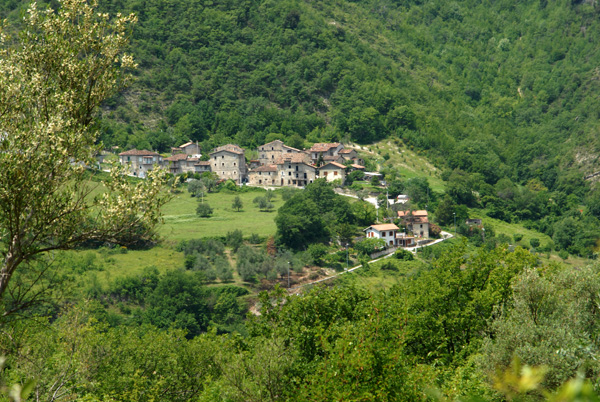
Villa San Vito is a small hilltop settlement overlooking the Tronto valley, a short distance from Acquasanta Terme. Its location, on a plateau served by ancient mule tracks that connected Quintodecimo, Morrice, and the Salaria, explains the village’s continuous habitation: people and goods (primarily chestnuts) passed through here, and the building fabric still preserves the imprint of that silent traffic today.
The medieval core is visible in the narrow alleys and stone houses, but it was primarily between the 16th and 17th centuries that the village made its mark: travertine portals and architraves bear dates and inscriptions (1518, 1562, circa 1564) and a quality of sculpture that points to local workshops influenced by Lombard craftsmen. String course frames, griffin-shaped corbels, and lowered arches are recurring features; similar elements can be found in nearby valley centers, indicating a shared building period.
The church of San Biagio, documented at least since 1413, is the historical and identity heart of the village. Single-naved, with a small rose window and sandstone architrave carved with the blessing saint, it houses a travertine altar, devotional niches, and a fresco of the Madonna and Child; another large Marian canvas, now in need of restoration, dominates the entrance wall. Outside, the simplicity of forms is striking, and on the rear, an unusual circular opening, perhaps related to defensive or minor liturgical functions, tells the story of the building’s adaptation over time.
Between the late Middle Ages and the modern era, Villa San Vito reached its peak of vitality: this is evidenced by the density of stone workmanship, the loggias, the arrow slits, and the blocked single-light windows that emerge in the masonry. The network of paths – traveled “at dawn” for trade with Quintodecimo – connected the village to the mountain economic system (wood, chestnut groves, pastures) and the valley markets. Even in the nineteenth century, the village maintained its autonomy and a compact social structure; then the twentieth century brought demographic decline, but left intact a widespread heritage of stone artifacts and an intact urban layout.