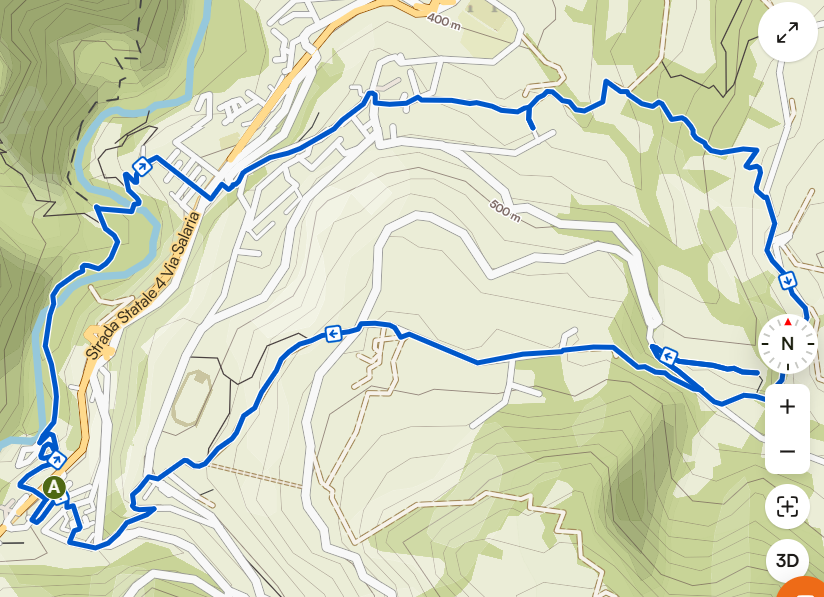

A circular route among sulfur springs, medieval villages, and sacred places: from Pacca della Vecchia to Lu Vurghe, from the churches of Santa Maria, Holy Crucifix, and San Lorenzo to the magnificent Castel di Luco and the Abbey of Valledacqua, with a panoramic return from Cagnano passing by San Giovanni Battista.
Thermal springs, ancient villages, and sacred places along the heart of Alto Tronto
This route combines the two souls of Acquasanta Terme:
👉 the land of waters, among sulfur springs and ancient thermal rituals
👉 the land of stones, where villages, churches, and castles tell a thousand years of history.
It is an itinerary that unfolds as a sensory journey, suitable for curious walkers and those who want to experience an authentic adventure in the Apennine landscape.
The journey begins at the historic spring below Acquasanta, known as Pacca della Vecchia, a place frequented for centuries for the properties of its waters. The path winds along the river and slowly ascends, amidst humid vegetation, the scent of the forest, and the constant sound of water accompanying the walk.
Continuing along the old river road, you reach Lu Vurghe, the ancient thermal settlement where sulfur waters freely used by travelers of the past spring forth.
Here, you can breathe the very origin of Acquasantana identity: warm waters, stone, tranquility. We are in the place where tradition places the oldest thermal core of Acquasanta.
Slightly ascending the village slope, you encounter the small and very ancient Church of Santa Maria, linked to historical sources that testify to the presence of sacred springs and ancient places of worship.
It is one of the most evocative places of the itinerary: silent, secluded, framed by greenery.
Reaching Paggese, the walk crosses an intact rural habitat. The small Church of the Holy Crucifix stands near the settlement: simple, essential, guardian of a centuries-old religious memory. The place retains its original atmosphere intact.
A few minutes and the path leads to the parish church of San Lorenzo, the religious center of the community since the 16th century. Its stones tell the centuries, the families, and the brotherhoods that have preserved the faith and life of the village here.
From Paggese, you take the small cobbled road leading to the manor through an emotional path immersed in nature.
The ascent is gentle, surrounded by:
🌿 scents of the undergrowth
🪨 dry stone walls and old boundary stones
🌬 subtle sounds of the wind brushing the cliff
In a few minutes, the castle suddenly appears: circular, ancient, imposing, one of the very few European examples of fortified architecture with a round plan.
The historic village of Luco, with its well, the murus grossum, the cistern, and the remains of the Palatium, defines a perfect picture.https://www.komoot.com/it-it/tour/2703265840
After Luco, the path continues in a more wooded environment until the ancient Abbey of Valledacqua, a monastic site mentioned in medieval sources as a reference point for the territory and linked to the presence of the Benedictines.
It is a place of absolute peace, immersed in nature and the narrative of the spiritual Apennines.
The path turns towards Cagnano, one of the most important historical villages of Acquasantano. The ascent is panoramic and offers views over the Tronto valley, with small stone houses and ancient agricultural paths.
The final descent leads back towards Acquasanta, passing by the Church of San Giovanni Battista, a building rich in history and an integral part of the religious system of the area.
From here, in a few minutes, you return to the starting point.