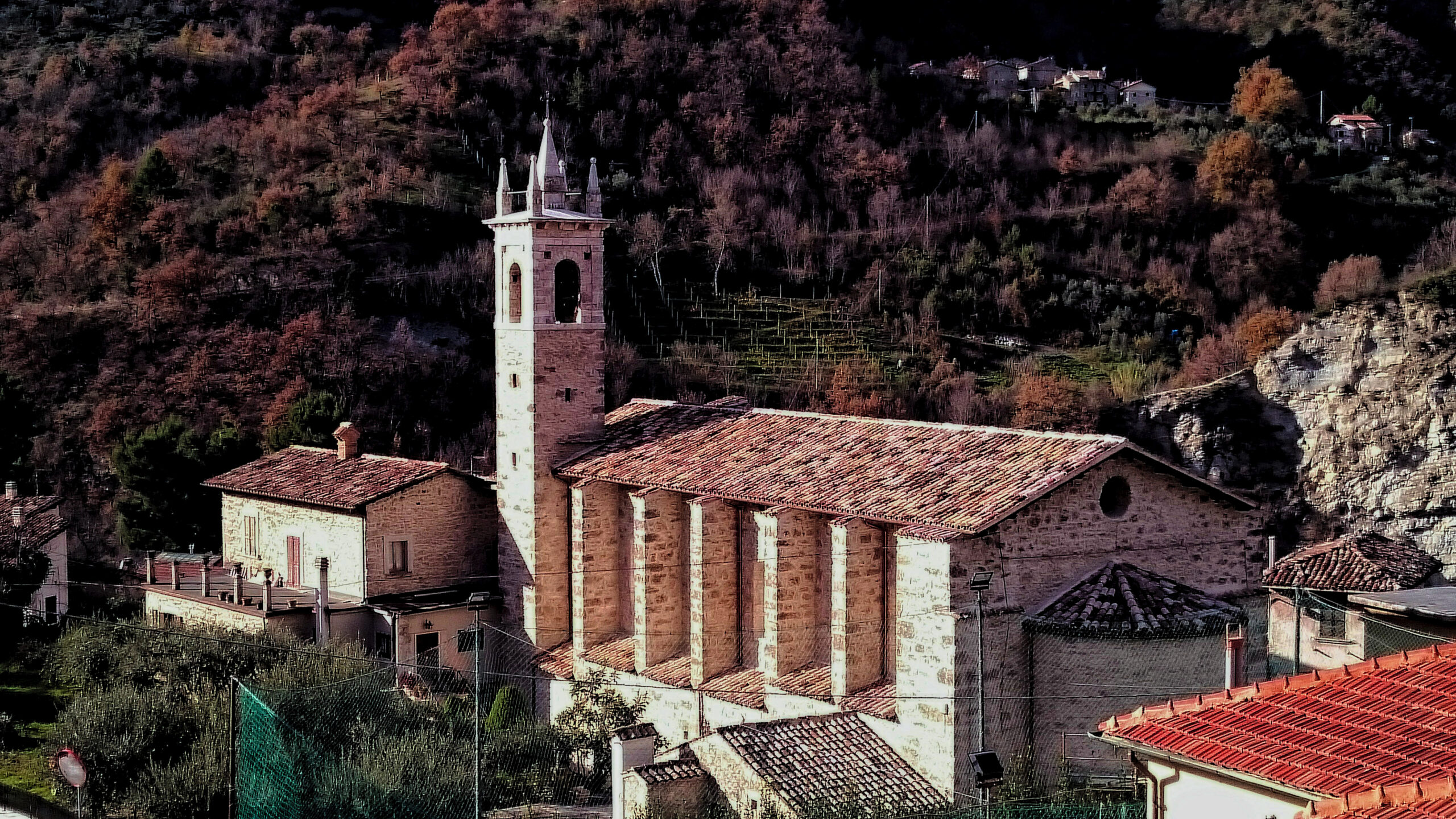
The Church of St. John the Baptist, located in the heart of the village of Acquasanta Terme, is a building with a centuries-old history, estimated by scholars to be around ten centuries old. Over time, it has undergone numerous interventions, modifications, and restorations, but still retains important architectural traces of its ancient construction phases, particularly visible on the north side, where evident signs of original entrances now walled up remain.
The exterior is simple and essential: the main portal features a pediment without decorations and the inscription “RENOVATA ET DEDICATA A.D. MDCCCXCV”, which recalls the restoration and dedication that took place in 1895.
The interior, with a single nave, surprises with its decorative richness: the vault, apse, and walls are entirely frescoed and adorned. The building houses several side chapels containing valuable works. Among these stand out two early 20th-century paintings, The Madonna of the Rosary and The Madonna of Loreto, created by G. Cantalamessa, a 19th-century painter and art critic from Ascoli.
Of particular interest is the small tabernacle placed behind the large crucifix on the altar: inside it is kept a relic of St. John the Baptist, traditionally linked to a curious episode of “theft” by the papal Acquasanta residents at the expense of the neighboring Abruzzese, but in reality, it arrived on site at the end of the 17th century.
The choir loft with the organ of the Veneto-Marchigiana school, the work of organ builder Giovanni Paci (junior), deserves attention. He belonged to a family that built over fifteen organs for the province of Ascoli between the 19th and early 20th centuries.
On the north wall, there is also a remarkable series of decorative elements from a 16th-century canopy, very similar to the one present in the church of San Lorenzo in Pagese, and also comparable to the tradition of the church of Santa Maria di Pomaro.
On the main altar, there is a painting depicting the Madonna and Child, St. John, St. Sebastian, and St. Mary Magdalene: it is an 18th-19th century copy of the original 16th-century work by Cola dell’Amatrice, now preserved at the Civic Art Gallery of Ascoli Piceno (since 1973).
Photo by Stefano Albanesi
Description taken from the text by Cristiano Pesci